

Woodland Park Zoo received a 1-year-old female South African lion, named Adia, from the Columbus Zoo and Aquarium in early November. Adia has been quarantined for the standard 30 days, and will undergo a full physical on Wednesday before her quarantine is over.
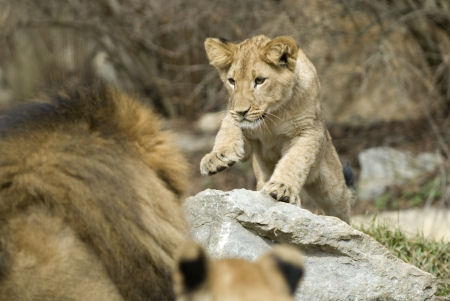
Photo by Grahm Jones, Columbus Zoo and Aquarium.
Named Adia (AH-dee-uh), which means “gift” in Swahili, the new lion arrived under a recommendation by the Species Survival Plan (SSP) for African lions. She will be paired for breeding with the zoo’s 11-year-old male lion when she reaches sexual maturity next fall. After clearing quarantine, Adia will be introduced gradually to the zoo’s award-winning African Savanna where she will rotate on exhibit. The male currently lives with another female, 11 years old.
All three lions belong to the South African subspecies, Panthera leo krugeri. Known as the Transvaal lion, it ranges in Southern Sahara to South Africa, excluding the Congo rain forest belt, in grassy plains, savanna and open woodlands.
The lion is perhaps the most iconographic of all the African savanna species. Their presence on the savanna immeasurably increases eco-tourism. In zoos, they help demonstrate the interdependency of all species. Although not endangered, African lions face an uncertain future, primarily due to the growth in human population. Poachers hunt lions for trophies and because they pose a threat to humans and livestock.


10 responses so far ↓
1 nettieboop // Nov 29, 2010 at 5:06 pm
Poor lion…
2 Megan the Vegan // Nov 29, 2010 at 6:25 pm
I hope he knows meat is murder.
3 Tahomajim // Nov 29, 2010 at 10:28 pm
Megan,
Lions have two choices, eat meat or starve. What’s your pleasure for them?
I’ve been to Africa, natives told me when they die they want to return as a male lion. I asked why.
Male lions eat, sleep, and have sex with every female lion in their pride. Female lions hunt and kill the food and raise the cubs.
Now, I realize that may not be attractive to some humans….. on the other hand it can be very attractive to other humans.
Here’s another thing I witnessed, I saw a big male lion with no mane….. It looked like a lioness but was a male…. a nasty male that could bring down a zebra alone. He had no pack of females to hunt for him…. he had no females cuz he was not normal.
The animal kingdom rules…. don’t try to change their behavior.
4 Janice R // Nov 29, 2010 at 11:05 pm
The animal kingdom rules…. don’t try to change their behavior>>> tahomajim
Keeping wild animals in a captive situation changes their behavior.
Also, haven’t you figured out yet that Megan the Vegan is a troll, just trying to illicit a now too predictable reaction?
5 Whopper // Nov 30, 2010 at 6:50 am
“Keeping wild animals in a captive situation changes their behavior.”
This is a captive-born lion, not born in the wild.
6 Janice R // Nov 30, 2010 at 10:21 am
This lion may have been captive born, but it is still a wild animal and as such has the instincts and needs of a wild animal. And yes, I understand she would probably not survive in the wild without lots of rehab so don’t go there. Having said that, I hope she has a fulfilling life at the zoo and is valued as more than a cute cub maker to draw crowds.
7 Greenwood // Nov 30, 2010 at 11:18 am
http://www.nytimes.com/2010/11/30/opinion/30zhuo.html?_r=1&ref=opinion
8 PhinneyNeighbor // Nov 30, 2010 at 12:32 pm
The lions have access to their outdoor enclosure. Back when Jake and Juanita were still in the main enclosure, one of the horticulture stiff told me that they had discovered a cache of bones in a corner outdoors. Apparently Juanita was going hunting for opossum at night.
9 Coffee:Black // Nov 30, 2010 at 5:10 pm
The lions and other predators have been known to kill local wildlife, such as the ducks that nest in the exhibits every year (many of them flying in from Greenlake). A couple of years ago there were monkeys in what is now the Duiker enclosure, they had problems with them grabbing ducklings out of the water and pulling their heads off. Mind you these monkeys were not predators and primarily ate flowers and fruit.
So, you are right that just because they are in captivity doesn’t mean that they are in any way tame and will take any opportunity to flex their instinctual muscles in order to hunt or even protect their territory. Why else do you think that the Red-Ruffed Lemurs make that crazy shrieking noise whenever they hear announcements on the loud speaker? They are marking proclaiming their familial territory.
10 Tahomajim // Nov 30, 2010 at 8:40 pm
Everybody,
See why our zoo AND PhinneyWood.com are important? Where else can you read factual information and dialog like above?
Somehow I doubt we’ll find such text on Maple Leaf or Wedgwood.com. I’ll check it out.
And Janice R. — I’m glad you wrote your thoughts even though you’re wrong.
Leave a Comment